
Every home’s water supply system is only as reliable as the tank storing it. Whether you’re building a new house, replacing an old tank, or upgrading your storage capacity, choosing the right water tank affects everything from daily water pressure to long-term hygiene and maintenance costs. With so many materials, sizes, and placement options available, it’s easy to get overwhelmed, this guide breaks down exactly what to consider before you buy.
At Nirmaan Pipes & Fittings, we manufacture roto-moulded water storage tanks built for Indian household conditions, and this guide draws on what we see matter most to homeowners across Jharkhand, Bihar, West Bengal, and Odisha.
Step 1: Calculate the Right Capacity for Your Household
Tank size is the first and most important decision, and it’s where many homeowners either overspend or under-provision.
General guideline: Indian households typically need 100–150 litres of water per person per day for drinking, cooking, bathing, and cleaning.
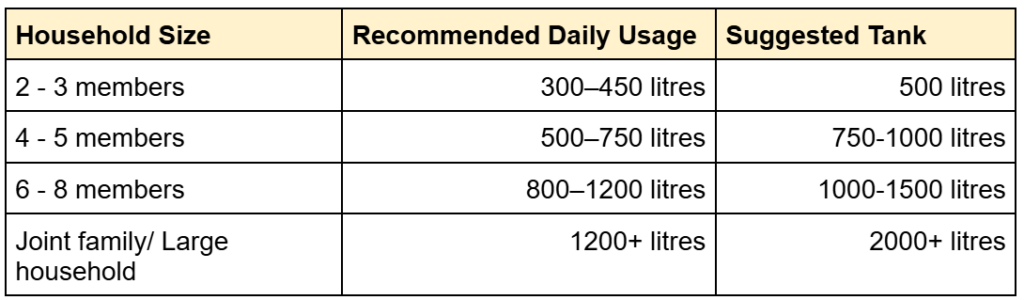
If your area experiences irregular municipal supply or seasonal water shortage, add a buffer of 1.5–2x your daily requirement so you’re not dependent on daily refilling.
Step 2: Decide Between Overhead and Underground Storage
Overhead tanks sit on the roof or an elevated stand and use gravity to supply water throughout the house. They’re the most common choice for Indian homes because they:
- Require no additional pump for basic water flow to lower floors
- Are easier to inspect, clean, and maintain
- Work well with roto-moulded tank designs
Underground or sump tanks are used as the primary collection point, especially when paired with a pump that lifts water to an overhead tank. These suit homes with:
- Limited roof space or structural load restrictions
- Borewell or tanker-based water supply that needs a large collection reservoir before distribution
- Two-tank systems (sump + overhead) for larger homes needing higher total storage
Most urban and semi-urban homes in Eastern India use a combination: an underground sump for bulk storage and an overhead tank for daily gravity-fed supply.
Step 3: Choose the Right Tank Material
This is where long-term durability and water safety are decided. Roto-moulded polyethylene tanks (like Nirmaan’s) are the most widely recommended option for Indian homes today because they offer:
- Seamless, single-piece construction and no welded joints that can crack or leak over time
- UV-stabilized outer layers, essential for rooftop tanks exposed to direct sun year-round
- Food-grade inner layers that don’t react with stored water, keeping it safe for drinking and cooking
- Corrosion resistance, unlike older metal tanks that rust and contaminate water
- Lightweight structure, reducing load stress on rooftops and stands compared to concrete or metal alternatives
Step 4: Check for Layer Construction and UV Protection
Not all roto-moulded tanks are built the same. When comparing options, look for:
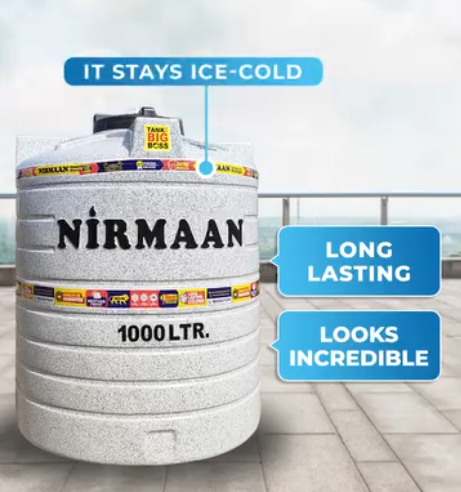
- 3-layer or 5-layer construction: A middle layer that blocks UV penetration prevents algae growth inside the tank, even when the tank sits in direct sunlight for years.
- Food-grade virgin plastic in the inner layer, rather than recycled material, which can leach unwanted compounds into stored water.
- A black or dark-colored inner/middle layer specifically, since this is what actually blocks light transmission and prevents algae growth, the outer color is cosmetic.
Step 5: Consider Installation and Space Constraints
Before finalizing a tank, measure your available rooftop or ground space and check:
- Tank diameter and height against your stand or sump dimensions
- Structural load capacity of your roof or stand, especially for tanks above 1000 litres when full
- Access for cleaning, since tanks should be inspected and cleaned at least once or twice a year
- Inlet/outlet and overflow pipe compatibility with your existing UPVC or CPVC plumbing network
Step 6: Factor in Maintenance Requirements
A good tank should require minimal upkeep, but all tanks benefit from:
- Annual or bi-annual cleaning to remove sediment buildup
- Periodic inspection of the lid/cover to prevent debris, insects, or contamination from entering
- Checking inlet float valves to prevent overflow and water wastage
Roto-moulded tanks with smooth interior surfaces make this maintenance significantly easier than concrete alternatives, where rough interior walls trap sediment.
Why Nirmaan Tanks
Nirmaan’s roto-moulded water storage tanks are manufactured with multi-layer UV-protected construction and food-grade inner surfaces, designed specifically for the storage and climate conditions found across Eastern India. Paired with our UPVC and CPVC piping ranges, Nirmaan offers a complete, compatible water storage and distribution solution for your home backed by our promise of Daam Sahi, Quality Zabardast.
To find the right tank size and specification for your home, reach out to your nearest Nirmaan dealer or visit our website nirmaanpipes.com .