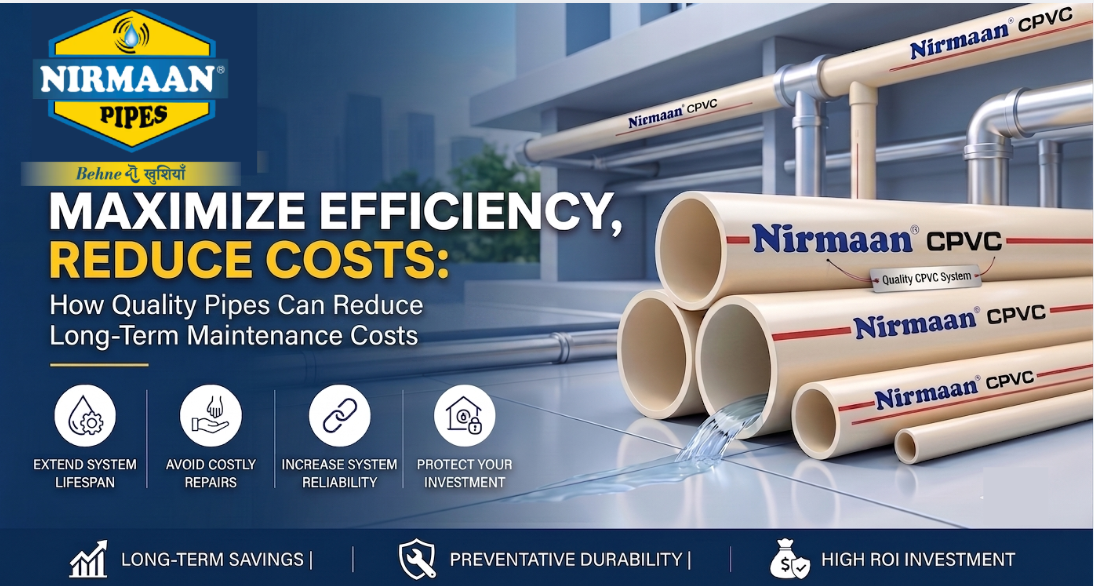
When building or renovating a home, commercial property, or agricultural project, most people focus on visible aspects like tiles, paint, and interiors. However, one of the most important investments lies behind the walls – the piping system. The pipes you choose today decide how much you’ll spend on repairs, replacements, and water damage over the next 15-20 years.
At NIRMAAN Pipes & Fittings, we’ve seen this pattern repeat across hundreds of projects in Jharkhand, Bihar, West Bengal, and Odisha: low-cost piping saves money upfront and costs far more later. Here’s exactly how quality piping protects your wallet over the long run.
The Hidden Cost of “Cheap” Pipes
A pipe that costs 20% less at the time of purchase can end up costing 3-4 times more over its lifetime once you factor in:
- Leak repairs – cutting into walls, floors, or roads to fix a burst pipe
- Water damage – to walls, flooring, furniture, and foundations
- Water loss – silent leaks that inflate your water bills for months before detection
- Contamination risk – degraded pipes leaching into drinking water
- Business disruption – for institutional and commercial projects, downtime during repairs
Low-grade PVC pipes often use recycled or substandard raw material, inconsistent wall thickness, and weak jointing systems. These defects don’t always show up on day one. They show up two monsoons later, when a joint fails under pressure or UV exposure makes the pipe brittle.
What Makes a Pipe “Quality” in the First Place
Not all pipes marked UPVC, CPVC, or SWR are equal. Quality is determined by a few measurable factors:
1. ISI Certification and Raw Material Grade
Pipes manufactured to ISI standards undergo strict testing for pressure tolerance, impact resistance, and material purity. Virgin PVC resin, rather than recycled material, ensures consistent strength across the entire length of the pipe.
2. Wall thickness Consistency
A pipe with uneven wall thickness has weak points that fail first under pressure. Reputable manufacturing processes maintain uniform thickness throughout, which is why NIRMAAN pipes carry ISO certified production standards.
3. UV and Weather Resistence
For exposed piping (like agricultural or external plumbing runs), UV stabilizers in the material prevent the pipe from becoming brittle and cracking after prolonged sun exposure.
4. Joint and Fitting Compatibility
A pipe is only as strong as its weakest joint. Solvent cement joints, threaded connections, and rubber-ring joints all need to be engineered to match the pipe’s expansion and contraction behavior, especially important in regions with high temperature swings.
5. Chemical and Corrosion Resistance
Unlike metal pipes, quality UPVC and CPVC pipes don’t rust or corrode. This is one of the biggest long-term maintenance advantages of PVC-based piping systems over older GI (galvanized iron) pipes.
Long-Term Cost Savings, Category by Category
Fewer leak Repairs
Quality pipes with proper wall thickness and certified jointing systems dramatically reduce the failure rate at joints, the single most common source of leaks. Fewer leaks mean fewer instances of breaking open finished walls, floors, or roads for repair.
Lower Water Loss
Undetected leaks in underground or wall-concealed pipes can waste thousands of litres over months. Quality piping systems maintain their seal integrity for decades, keeping your actual water consumption in line with billed consumption.
Reduced Replacement Frequency
A quality UPVC or SWR pipe system, properly installed, is built to last 25+ years. A substandard system may need partial or full replacement within 5-8 years, and replacement work always costs more than the original installation because it involves demolition and restoration.
No Corrosion-Related Costs
Metal pipes eventually rust, restricting flow and eventually failing. PVC-based systems eliminate this entire cost category, no scaling, no corrosion-related pressure loss, no rust-contaminated water.
Lower Maintenance Labor
Every emergency repair call, plumber visit, or maintenance contractor visit adds up. Systems built with quality pipes need far fewer of these visits across their lifetime, which matters even more for institutional projects like railway installations, industrial plants, or government housing schemes where downtime has a real operational cost.
Calculating the Real ROI of Quality Piping
Think of it this way: the price difference between a standard-grade pipe and a premium-grade pipe is typically a small percentage of total project cost. But the cost of even one major leak repair, including demolition, plumbing labor, and restoration, can equal or exceed the entire piping budget for a small section of the project.
When you factor in a 20-25 year usage horizon, quality piping isn’t an added expense. It’s a
cost-avoidance strategy.
Conclusion
Piping is one of the few construction decisions where the cheapest option almost always becomes the most expensive one over time. Quality piping reduces leak frequency, eliminates corrosion-related costs, cuts down on emergency repairs, and extends the usable life of the entire plumbing system by decades.
At NIRMAAN Pipes & Fittings, our UPVC, CPVC, SWR, and casing pipes are manufactured to ISI standards under ISO certified processes, built on the promise of “Daam Kam, Quality Zabardast.” When you choose quality at the start, you’re not spending more, you’re spending once.
Looking to upgrade your project’s piping system? Explore NIRMAAN’s full product range or reach out
to our team for guidance on the right piping solution for your application.